




If you've been dealing with a deep, aching pain in your buttock that shoots down your leg, you're probably desperate for answers. That nagging discomfort that flares up every time you sit too long or climb stairs can make even simple activities feel exhausting.
The good news? Piriformis syndrome usually responds well to simple stretches and home care. This guide will help you understand what's going on, figure out if piriformis syndrome is likely the cause, and give you specific stretches you can try today.
What is Piriformis Syndrome?
Piriformis syndrome is a condition where the piriformis muscle in your buttock compresses the sciatic nerve, causing deep pain that radiates down the back of your leg.
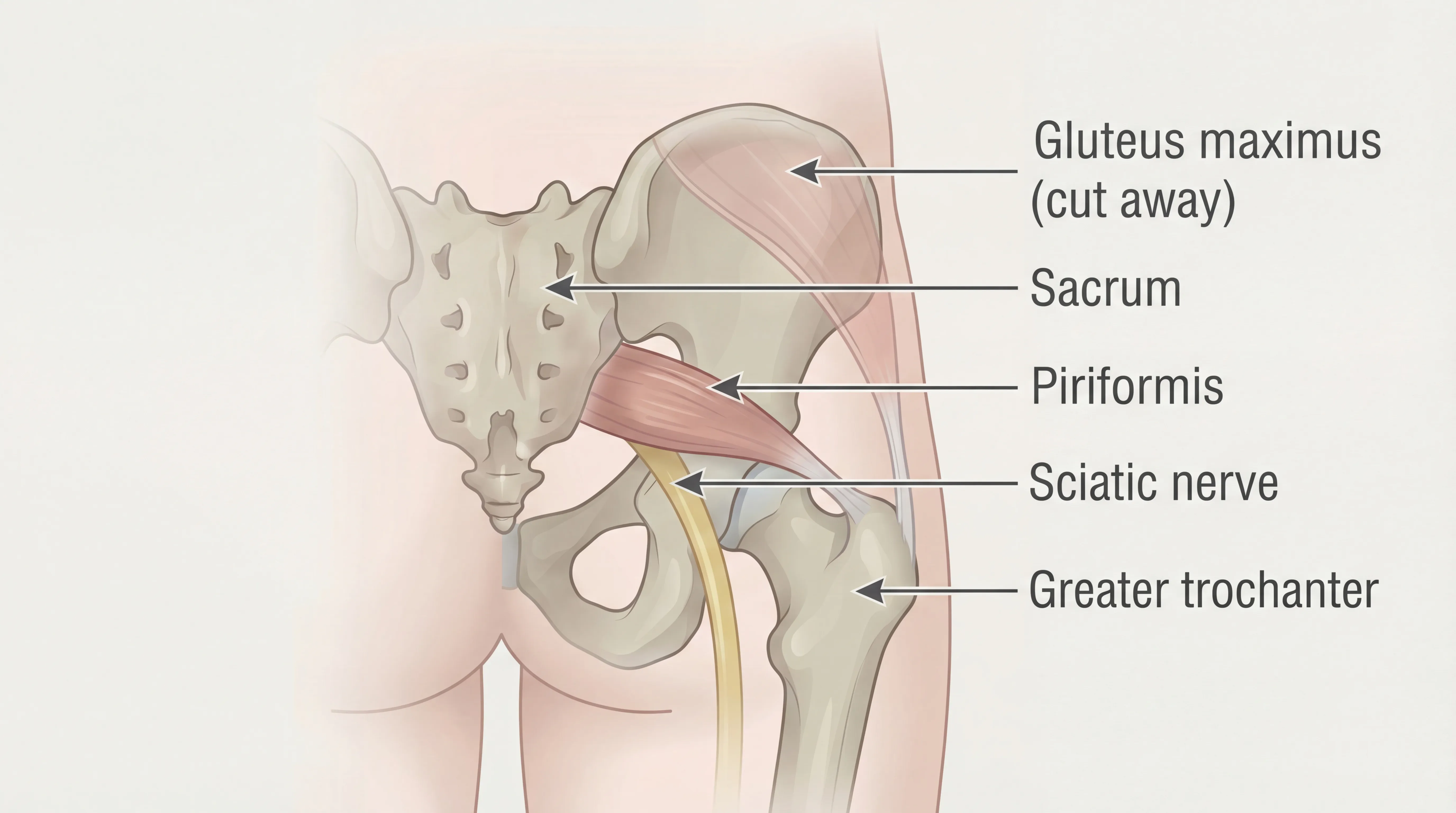
The piriformis is a small, flat muscle located deep in your buttock, running from your lower spine to the top of your thighbone. Unlike true sciatica from spinal disc problems, piriformis syndrome originates in the muscle itself. The sciatic nerve passes either through or directly beneath this muscle. When the piriformis becomes tight, inflamed, or spasms, it can squeeze the nerve and trigger pain.
This condition is especially common among runners, cyclists, and people who sit for long periods. If you spend hours at a desk in Wynwood or Downtown Miami, or spend your commute stuck in traffic on SW 8th Street, you're at higher risk. Miami's car-centric lifestyle means many residents sit far more than they realize.
Do I Have Piriformis Syndrome?
You likely have piriformis syndrome if you feel deep buttock pain that worsens with sitting, shoots down your leg, and improves when you stand or walk.
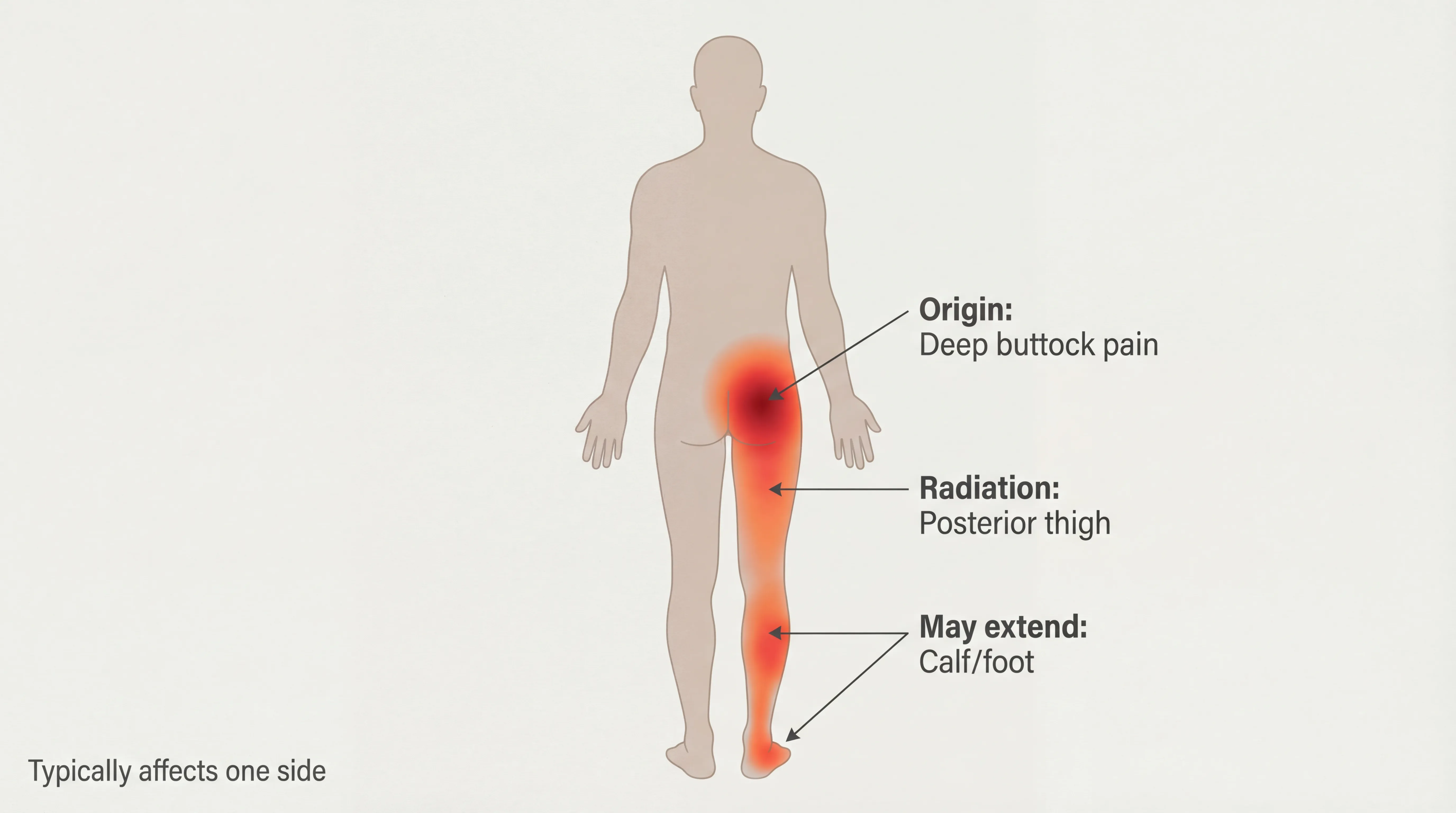
Here's a quick self-check. The pain typically affects one side only. If you answer "yes" to 3 or more of these, piriformis syndrome is likely:[1]
- Deep ache in one buttock?
- Pain that shoots down the back of your thigh?
- Worse after sitting for 20+ minutes?
- Better when you stand up and walk around?
- Pain with climbing stairs?
How to tell the difference:
Piriformis syndrome vs. sciatica - With piriformis syndrome, your pain starts in the buttock and may travel down the leg. True sciatica from a herniated disc typically starts in the lower back.[3] If your back feels fine but your buttock and leg hurt, piriformis syndrome is more likely. Our full comparison guide walks through the self-tests that help separate them.
Piriformis syndrome vs. hip pain - Hip problems usually hurt with hip rotation or when you move your leg in circles. Piriformis pain stays focused in the buttock and down the leg, not in the hip joint itself.
If your symptoms don't match these patterns, it's worth getting a professional evaluation to rule out other causes.
5 Stretches for Piriformis Relief
The five most effective piriformis stretches are the supine piriformis stretch, seated figure-4, pigeon pose, standing stretch, and knee-to-chest with rotation.[4]
Hold each stretch for 30 seconds, repeat 2-3 times daily, and most people notice improvement within a few days of consistent stretching.
1. Supine Piriformis Stretch
- Lie on your back with both knees bent
- Cross your affected leg over the other, resting your ankle just above the knee
- Reach through and grab the back of your bottom thigh
- Gently pull toward your chest until you feel a stretch in your buttock
Hold 30 seconds. Repeat 2-3 times. This is the most effective piriformis stretch for most people. Go slowly and breathe through it.
2. Seated Figure-4 Stretch
- Sit in a chair with feet flat on the floor
- Cross your affected leg so your ankle rests on your opposite knee
- Keeping your back straight, lean forward gently
- Stop when you feel a stretch deep in your buttock
Hold 30 seconds. Repeat 2-3 times. Perfect for the office. You can do this at your desk without anyone noticing.
3. Pigeon Pose
- Start on hands and knees
- Bring your affected leg forward, placing the knee behind your wrist
- Slide your other leg straight back
- Lower your hips toward the floor
- For beginners: keep your front shin angled rather than parallel to your hips
Hold 30 seconds. Repeat 2-3 times. If this feels too intense, place a pillow under your hip for support.
4. Standing Piriformis Stretch
- Stand facing a table or counter at hip height
- Place your affected leg on the surface with knee bent at 90 degrees
- Keep your standing leg straight
- Lean forward slightly, hinging at the hips
Hold 30 seconds. Repeat 2-3 times. Great when you need a quick stretch and can't get on the floor.
5. Knee-to-Chest with Rotation
- Lie on your back
- Pull your affected knee toward your chest
- Gently guide the knee across your body toward the opposite shoulder
- Keep your shoulders flat on the floor
Hold 30 seconds. Repeat 2-3 times. This gentle stretch is ideal first thing in the morning before getting out of bed.
Sleeping with Piriformis Pain
The best sleeping position for piriformis pain is on your side with a pillow between your knees to maintain hip alignment and reduce pressure on the muscle.
Avoid stomach sleeping entirely, as this position keeps the piriformis in a stressed position all night. Why does sleep position matter? When you sleep, your muscles relax, but poor alignment can keep the piriformis in a shortened or stressed position all night. You wake up stiff and sore, and the cycle continues.
Morning tip:
Before you even get out of bed, do the knee-to-chest with rotation stretch on each side. This helps release overnight tightness before you put weight on your legs.
For side sleepers, make sure your pillow is thick enough to fill the gap between your knees completely. A thin pillow doesn't do much. Some people find a body pillow works better than a standard one.
Piriformis Syndrome Home Relief
For quick piriformis relief at home, apply ice for 15-20 minutes during the first 48-72 hours, then switch to heat after inflammation subsides and use tennis ball self-massage.[7]
Ice vs heat rule: Use ice when you have sharp pain or after an activity that aggravates it. Use heat when the pain is more of a dull ache or when muscles feel tight. Miami's year-round warmth can make heat packs feel excessive, so a warm shower often works just as well.

Tennis ball self-massage: Sit on a firm surface with a tennis ball under your buttock, right on the sore spot. Roll gently or just let your weight sink into the ball for 30-60 seconds. This helps release muscle tension.
Sitting modifications: If you sit for long periods, whether at a desk in Brickell or stuck in traffic on I-95, take a break every 30 minutes to stand and walk around. A donut cushion or seat cushion can reduce pressure on the piriformis while sitting.
OTC options: Anti-inflammatory medications like ibuprofen can help manage pain and inflammation short-term. Follow package directions and don't rely on them for more than a week or two without talking to a doctor.
When to See a Doctor for Piriformis Syndrome
See a doctor if piriformis pain doesn't improve after 2-3 weeks of stretching, if you have leg numbness or weakness, or if pain limits daily activities.[5]
Early professional evaluation can rule out other conditions and speed recovery.
If you experience numbness in your groin area, loss of bladder or bowel control, or rapidly progressing weakness in your leg, go to the emergency room. These symptoms could indicate a serious nerve problem that needs urgent care.
Who to see: A physical therapist can evaluate your movement patterns and give you targeted exercises. Sports medicine doctors and orthopedists can rule out other conditions. Many people start with their primary care doctor for a referral.
What to expect: The doctor will ask about your symptoms, examine your hip and back, and may perform tests that stretch the piriformis to see if it reproduces your pain.[6] Imaging like MRI is sometimes used to rule out other causes.
Piriformis Syndrome Treatment Options
Most piriformis syndrome resolves with stretching and home care within 2-6 weeks, though persistent cases may need physical therapy, massage, or injections.
Surgery is rare and only considered after all conservative treatments have failed for an extended period.
Physical therapy: A PT can identify muscle imbalances or movement patterns contributing to your problem. Treatment often includes targeted stretching, strengthening exercises, and manual therapy to release the piriformis directly.[4]
Massage therapy: Deep tissue massage can release chronic tension in the piriformis. Many people find regular massage helpful for maintenance after the acute pain resolves.
Chiropractic care: Some chiropractors address piriformis syndrome through pelvic alignment and spinal mechanics. Research on effectiveness is mixed, but some patients report benefit.
Injections: For persistent cases, a corticosteroid injection into the piriformis muscle can reduce inflammation. Botox injections are sometimes used to relax a chronically tight muscle.[5]
Surgery: Piriformis release surgery is very rare and only considered after all conservative treatments have failed for an extended period. Most people never need it.

Piriformis Syndrome Treatment Costs
Understanding piriformis syndrome treatment costs helps you plan financially and choose the right care option, with most cases responding well to conservative treatments that cost significantly less than injections or surgery.
Conservative treatment costs
Physical therapy: $75-200 per session without insurance, typically requiring 1-2 sessions per week for 4-8 weeks. Most insurance plans cover PT with a copay of $20-50 per visit. Total out-of-pocket with insurance: $160-400 for a typical treatment course.
Massage therapy: $60-120 per session, with most patients finding relief after 4-8 sessions. Massage is often not covered by insurance, though some plans offer wellness benefits.
Chiropractic care: $65-150 per session. Coverage varies widely by insurance plan.
Home care supplies: Tennis balls ($3-5), foam rollers ($15-40), and seat cushions ($25-50) are one-time purchases that support ongoing self-care.
Injection costs
Piriformis muscle injection: $500-1,500 per injection without insurance. With insurance, expect $50-300 out-of-pocket depending on your plan. Injections are typically only recommended when conservative treatment has failed.
Botox injections: $1,000-2,500 per treatment for chronic cases. Insurance coverage varies and may require prior authorization.
Insurance considerations
- Physical therapy referrals: Some plans require a referral from your primary care doctor before covering PT
- Visit limits: Many plans limit the number of PT or chiropractic visits per year
- In-network providers: Using in-network providers can reduce costs by 30-60%
- Deductibles: Early-year treatment may cost more if you haven't met your deductible
Financial assistance options
- Payment plans: Many PT clinics and providers offer interest-free payment plans
- HSA/FSA: Use pre-tax dollars to pay for treatment, reducing effective cost by 20-30%
- Workers' compensation: If your piriformis syndrome is work-related (from prolonged sitting or repetitive activities), workers' comp may cover treatment
- Sliding scale fees: Some clinics offer reduced rates based on income
Cost-Saving Tip:
Piriformis syndrome often responds well to the free stretches in this guide. Try consistent daily stretching for 2-3 weeks before paying for professional treatment. If you do need care, physical therapy is typically more cost-effective than repeated injections and addresses the underlying cause.
Piriformis Syndrome FAQ
1 How long does piriformis syndrome take to heal?
2 Can piriformis syndrome go away on its own?
3 Is walking good for piriformis syndrome?
4 What makes piriformis syndrome worse?
5 Should I use heat or ice for piriformis pain?
Next Steps
Start the stretches and home care tips in this guide today, commit to 2-3 weeks of consistent daily effort, and seek professional evaluation if symptoms don't improve.
Once you're feeling better, Miami's year-round warmth makes it easy to stay active. Walking paths at Bayfront Park offer low-impact exercise that can help keep your piriformis loose and prevent recurrence.
References
- The clinical features of the piriformis syndrome: a systematic review. Eur Spine J. 2010 ;19 (12) :2095-2109 . DOI PubMed
- Piriformis syndrome: diagnosis, treatment, and outcome - a 10-year study. Arch Phys Med Rehabil. 2002 ;83 (3) :295-301 . DOI PubMed
- Diagnosis and management of piriformis syndrome: an osteopathic approach. J Am Osteopath Assoc. 2008 ;108 (11) :657-664 . PubMed
- Treatment of an individual with piriformis syndrome focusing on hip muscle strengthening and movement reeducation: a case report. J Orthop Sports Phys Ther. 2010 ;40 (2) :103-111 . DOI PubMed
- Piriformis muscle syndrome: diagnostic criteria and treatment of a monocentric series of 250 patients. Ann Phys Rehabil Med. 2013 ;56 (5) :371-383 . DOI PubMed
- Piriformis muscle syndrome: a cross-sectional imaging study in 116 patients and evaluation of therapeutic outcome. Eur Radiol. 2018 ;28 (2) :447-458 . DOI PubMed
- Brief review: piriformis syndrome: etiology, diagnosis, and management. Can J Anaesth. 2013 ;60 (10) :1003-1012 . DOI PubMed
Need hands-on treatment for piriformis pain in Miami?
Learn About Our ApproachOr call (786) 480-0026