



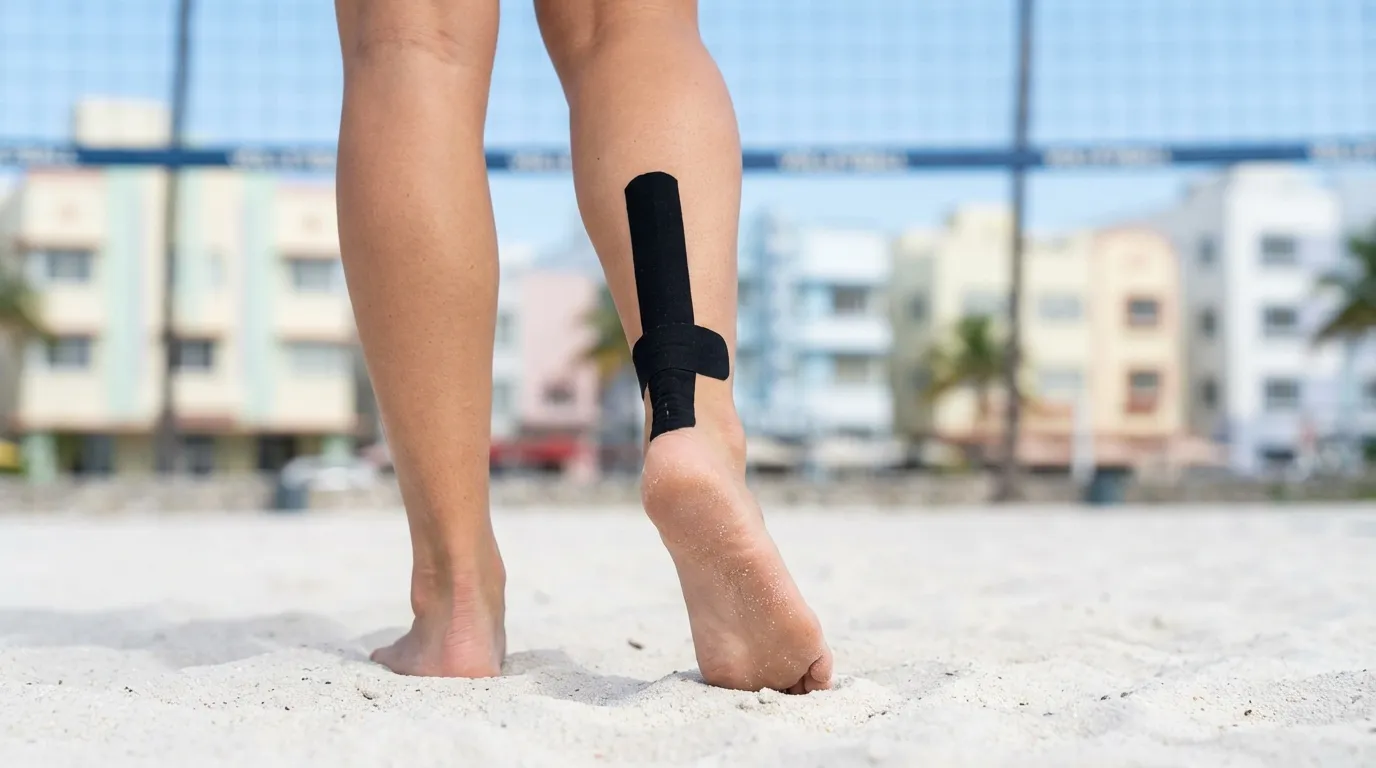
Achilles Tendonitis: Key Takeaways
Achilles tendonitis develops when the tendon connecting your calf muscles to your heel bone becomes irritated from repeated overload, contributing to pain, stiffness, and swelling near the back of your ankle. Most cases respond to conservative treatment, with 75-90% resolving without surgery.1 This guide covers the causes, symptoms, home care, and every treatment option available in Miami so you can make an informed decision about your next step.
What Is Achilles Tendonitis?
Achilles tendonitis develops when repeated stress damages the largest tendon in the human body, the thick band of tissue connecting your calf muscles to your heel bone that absorbs forces of 3 to 12 times your body weight during running.2
The condition comes in two forms. Insertional tendinopathy affects the tendon where it attaches to the heel bone and sometimes involves bone spurs. If you are dealing with pain right at the heel bone, our guide to heel spur covers the insertional angle in more detail. Mid-portion tendinopathy develops 2 to 6 centimeters above the heel, where the tendon's blood supply is poorest. Mid-portion cases account for 55-65% of all Achilles tendon disorders.1
An important distinction: what starts as tendinitis (acute inflammation) often progresses to tendinosis, a degenerative condition where the healing response has failed rather than active inflammation persisting.2 This matters because treatments aimed at reducing inflammation may provide symptom relief but do not address the underlying tendon degeneration.
Achilles tendinopathy is the most common overuse injury of the lower extremity, with prevalence at roughly 6% in active populations, rising to 8% in those over 45.1 3 Runners are particularly affected because each stride loads the tendon thousands of times per session, with some studies estimating that up to 50% of competitive distance runners experience Achilles problems during their careers.3
Achilles Tendonitis Symptoms
Achilles tendonitis produces a recognizable pattern of pain and stiffness that typically worsens with activity, often starting as morning tightness near the back of the ankle and progressing to persistent discomfort during and after exercise.
Common symptoms include:
- Pain along the tendon or at the heel insertion that worsens after exercise
- Stiffness first thing in the morning or after sitting for extended periods
- Swelling that increases throughout the day
- Visible thickening of the tendon compared to the unaffected side
- A creaking or crackling sensation (crepitus) when moving the ankle through its range of motion
- Pain that initially appears only after activity, then begins occurring during activity
- Needing to switch between shoes throughout the day to find a pair that does not aggravate the pain
Symptom progression typically follows a predictable path: mild morning stiffness gives way to persistent pain during activity, then pain at rest, and eventually difficulty walking. Each stage reflects increasing tendon disrepair. In the earliest phase, overnight rest partially restores tendon stiffness, which is why morning pain fades within minutes. As the condition advances, the tendon's collagen structure deteriorates and pain lingers longer.
Runners often notice it first as a nagging ache that appears midway through a run and forces them to cut it short, and then one morning it hurts just stepping out of bed after an evening pickleball session at Crandon Park. That is your body signaling the tendon is under more load than it can handle.
A misdiagnosis to watch for: Pain behind the inner ankle may actually be flexor hallucis longus (FHL) tendonitis rather than Achilles tendonitis. The FHL tendon runs parallel to the Achilles, and the two conditions are commonly confused. If your pain is located more behind or to the inner side of the ankle, mention this to your provider, as treatment differs.
- A sudden sharp pain accompanied by a popping or snapping sensation (possible Achilles rupture)
- Inability to push off your foot or rise onto your toes
- Significant swelling or bruising that develops rapidly
These signs may indicate a partial or complete Achilles tendon rupture, which requires urgent medical evaluation.
What Causes Achilles Tendonitis?
Achilles tendonitis usually results from repetitive tendon overload that outpaces the body's ability to repair itself, driven by a combination of training errors, biomechanical dysfunction, and lifestyle factors that keep the tendon under constant strain.
The kinetic chain: how your hips affect your Achilles
One of the most overlooked contributors to Achilles tendonitis is what happens far upstream of the tendon itself. A tilted pelvis, usually on the dominant-hand side, causes the psoas and hip flexors to shorten. This pulls the pelvis forward, creating a subtle forward lean. The body compensates by increasing calf activation to maintain upright posture.
The gastrocnemius remains chronically contracted, transmitting excessive pulling force to the Achilles tendon. The tendon never fully unloads, cumulative microdamage exceeds repair capacity, and tendinopathy develops.
In our clinical experience, this pelvic tilt pattern is present in the majority of Achilles tendonitis cases we evaluate.
Try this: Stand comfortably and notice your calf tension. Now lean forward 10 degrees. Your calves tighten immediately. That is what happens all day when tight hip flexors pull your pelvis forward.
This same posterior chain mechanism contributes to plantar fasciitis, which frequently co-occurs with Achilles tendonitis because both conditions share the overloaded calf-to-heel pathway. For a side-by-side comparison, see our guide to plantar fasciitis vs heel spurs vs Achilles tendonitis. For a broader look at related conditions, see our guide to foot and ankle pain relief in Miami.
Risk factors
- Weekend warrior pattern. Sedentary weekdays cause the tendon to lose conditioning. Explosive weekend activity then exceeds adapted capacity, contributing to microtears at the tendon's weakest point.4
- Age over 45. Tendon vascularity decreases with age, slowing collagen turnover so microdamage accumulates faster than the body can repair.2 3
- Tight calf muscles. A shortened gastrocnemius increases resting tension on the Achilles, closing the recovery window that microdamage repair requires.
- Flat feet and overpronation. Excessive pronation alters force distribution at heel strike, increasing uneven stress across tendon fibers.2
- On-your-feet occupations. Sustained standing during 8 to 12 hour shifts, common for nurses at Jackson Memorial and hospitality workers across Miami, keeps the calf muscles tonically contracted, which prevents the micro-rest periods the tendon needs to repair daily microdamage.
- Dehydration. In South Florida's year-round heat, inadequate fluid intake reduces blood flow to tendon tissue, impairing the healing response.
Miami-specific factors compound these risks. Year-round outdoor activity eliminates the natural off-season recovery period that colder climates provide. The pickleball culture across South Florida involves quick lateral movements and explosive push-offs that generate high peak forces through the Achilles, especially during the eccentric braking phase when you change direction. Runners training along Douglas Road encounter uneven sidewalk surfaces that add irregular loading to every stride.
Achilles Tendonitis Home Care: What You Can Do Today
Most mild cases of Achilles tendonitis respond well to structured home care when started early, combining reduced activity load with targeted exercises that stimulate tendon repair rather than simply resting and waiting for pain to resolve.
Reduce activity load, but do not stop completely. Complete rest weakens tendon tissue and often leads to a cycle where the pain returns as soon as you resume normal activity. Instead, lower your intensity and avoid activities that produce sharp pain. Ice for 15 to 20 minutes after activity. Avoid walking barefoot on hard floors.
Start an eccentric heel-drop protocol. The Alfredson protocol has the strongest evidence base for Achilles tendinopathy. Stand on a step edge with your heels hanging off. Rise up on both feet, then slowly lower one heel below the step level over 3 to 5 seconds. Perform 3 sets of 15 repetitions, twice daily, for 12 weeks.5 Some discomfort during the early weeks is normal.
Heavy slow resistance (HSR) as an alternative. If eccentric drops are too painful, weighted heel raises through full range of motion, performed 3 times per week, show equal outcomes with higher patient satisfaction.6 The 2024 JOSPT clinical practice guideline recommends tendon-loading exercise as a first-line treatment.7
Exercise Outdoors Year-Round:
Miami's warm climate means you can do eccentric heel drops outdoors on any step, curb, or low wall. Consistency matters more than setting.
Stay hydrated. Aim for half your body weight in ounces of water daily at minimum. Add more for activity in South Florida heat.
What to avoid: Pushing through sharp pain. Sudden return to full activity. Complete rest or immobilization. Flat, unsupportive footwear for extended periods.
When home care is not enough: If pain persists beyond 4 to 6 weeks of consistent effort or interferes with daily activities, professional evaluation is warranted.
Achilles Tendonitis Treatment Options
Achilles tendonitis treatment ranges from simple activity modification to targeted therapies that address the muscular restrictions behind chronic tendon overload. Conservative management succeeds in the majority of cases.1
Conservative care (rest, ice, NSAIDs, orthotics)
Rest from aggravating activities, ice after exercise, anti-inflammatories, and heel lifts can reduce symptoms in mild cases within 2 to 6 weeks. Pros: Accessible, low-cost. Cons: Does not address muscular or biomechanical causes. NSAIDs may provide less benefit than expected because chronic tendinopathy is degenerative, not inflammatory.2
Exercise therapy (eccentric and heavy slow resistance)
Exercise-based treatment has the strongest evidence base, with 80% full recovery at 5-year follow-up.8 Both the Alfredson eccentric protocol5 and heavy slow resistance6 produce significant improvements. Pros: Strongest evidence, durable outcomes, home-based. Cons: 12-week commitment; about 20% do not fully recover.
Physical therapy
Physical therapy combines exercises with manual therapy and gait retraining under professional supervision. Pros: Professional guidance, evidence-based. Cons: 6 to 12 weeks of appointments, cost accumulates, and some programs focus on the tendon without assessing upstream contributors.
TheraMax (robotic muscular therapy)
TheraMax uses sustained mechanical pressure to release chronic muscular tightness in the hip flexors, quadriceps, and calves that contributes to tendon overload, starting with pelvic tilt correction. A typical protocol involves 4 to 6 sessions over 3 to 4 weeks. Pros: Designed to address upstream muscular contributors other treatments often miss; sustained deep pressure. Cons: Not typically covered by insurance; limited availability; newer modality; cannot address structural damage such as partial tears or bone spurs. Best for: Biomechanical dysfunction. Not best for: Structural tendon damage.
Chiropractic care
Chiropractic care uses spinal and pelvic adjustments to improve alignment and gait. Pros: Non-invasive. Cons: Limited Achilles-specific evidence; does not address tendon tissue directly.
Shockwave therapy (ESWT)
Acoustic waves stimulate tendon healing, especially when combined with eccentric exercise.9 Pros: Non-invasive. Cons: Variable evidence quality. Best for chronic cases lasting 6 or more months.
Injections (cortisone and PRP)
Cortisone provides fast pain relief but weakens tendon tissue with repeated use. PRP takes a biologic approach, but evidence remains mixed.9 Cortisone carries rupture risk; PRP is expensive with inconsistent evidence.
Surgery
Surgery is a last resort after 6 or more months of failed conservative treatment, with up to 90% satisfaction but 4 to 6 months of recovery.9
Treatment comparison table
| Treatment | Timeline | Best For |
|---|---|---|
| Rest / Ice / NSAIDs | 2-6 weeks | Acute/mild cases |
| Exercise Therapy (Eccentric/HSR) | 12+ weeks | Chronic mid-portion tendinopathy |
| Physical Therapy | 6-12 weeks | Moderate-to-severe cases |
| TheraMax (robotic muscular therapy) | 4-6 sessions, 3-4 weeks | Biomechanical dysfunction |
| Chiropractic Care | 6-12 visits | Pelvic/spinal misalignment |
| Shockwave Therapy | 3-6 sessions | Chronic cases (6+ months) |
| Injections (Cortisone/PRP) | Days-months | Severe pain or refractory cases |
| Surgery | 4-6 months recovery | Failed conservative care |
How TheraMax Addresses Achilles Tendonitis
TheraMax robotic therapy is designed to release the chronic muscular tightness in the hips, quadriceps, and calves that may contribute to Achilles tendon overload. The tendon itself is rarely the whole story: most cases involve upstream muscular restriction presenting as tendon pain, and those upstream contributors are where treatment begins.
The session starts with a pelvic tilt assessment. If a tilt is present, the therapist begins with psoas release, applying steady pressure for approximately 30 minutes to reduce the forward lean that may be overloading the calves. After addressing pelvic tilt, the therapist moves to the gastrocnemius at a 45-degree angle, gradually working up to 85-100% of the effective pressure range. Sessions taper to monthly maintenance as the body adapts.
Some tenderness for a few days after sessions is normal. Sustained pressure temporarily displaces fluid from the fascia surrounding the muscle, and the tissue rehydrates over the following 24 to 48 hours. Drinking water after a session supports that rehydration process. TheraMax addresses the muscular component and complements but does not replace exercise protocols for tendon remodeling.7
For a detailed look at our approach, see our Achilles tendonitis care options at TheraMax.
Achilles Tendonitis Recovery: Natural vs. TheraMax
Your body heals the Achilles tendon through a natural collagen remodeling process, but this takes time and the right mechanical environment. Recovery varies significantly depending on whether you rely on self-directed care alone or combine it with professional treatment addressing upstream biomechanical factors.
Recovery comparison table
| Aspect | Natural Recovery (Self-Directed) | With TheraMax |
|---|---|---|
| Timeline | 3-6 months; chronic cases 12+ months. 80% full recovery at 5 years.8 | Typically 4-6 visits across 3-4 weeks (muscular component); exercise protocol continues alongside. |
| What you do | Daily eccentric or HSR exercises for 12 weeks; activity modification; ice after activity. | Weekly sessions for 3-4 weeks; resume exercise next day if feeling well; maintain hydration. |
| Compliance | 180 reps/day, 7 days/week, 12 weeks. Rates: 78-92%.6 | Weekly appointments; lower self-directed burden between sessions. |
| Recurrence | ~20% still symptomatic at 5 years.8 Higher if biomechanical causes persist. | Designed to address upstream contributors; monthly maintenance recommended. |
In our clinical experience, most clients report feeling improvement within 1-3 sessions when tight muscles are part of the problem. The advantage of living in Miami is that warm weather supports year-round consistency with eccentric or HSR protocols, which is a key factor in long-term tendon recovery.
Learn how TheraMax addresses muscular contributors to Achilles tendon pain
See Our ApproachOr call (786) 480-0026
How to Prevent Achilles Tendonitis
Preventing Achilles tendonitis requires addressing the biomechanical and lifestyle factors that overload the tendon. These strategies apply whether you have recovered from a previous episode or want to avoid one altogether.
- Follow the 10% rule. Increase weekly mileage or training intensity by no more than 10% at a time.
- Maintain calf strength. Eccentric heel drops 2 to 3 times per week serve as maintenance, not just treatment.
- Check your biomechanics. If you have recurring Achilles issues, consider having your gait and pelvic alignment assessed.
- Wear supportive footwear. Avoid prolonged use of flat, unsupportive shoes.
- Hydrate aggressively. In South Florida's heat, aim for 80 to 100 ounces of water daily, more if you train outdoors.
- Warm up before activity. Dynamic calf stretches and gradual intensity increases prepare the tendon for load.
- Cross-train. Trail surfaces at Oleta River State Park offer lower-impact terrain compared to concrete along the Rickenbacker Causeway.
Simple Weekly Maintenance:
After full recovery, 3 sets of 15 eccentric heel drops twice per week takes less than 10 minutes and significantly reduces recurrence risk.
Frequently Asked Questions About Achilles Tendonitis
1 Can I still play pickleball in Miami with Achilles tendonitis?
2 Does Miami's heat affect Achilles tendonitis recovery?
3 What is the difference between Achilles tendonitis and a torn Achilles tendon?
4 Could my ankle pain be something other than Achilles tendonitis?
5 How does TheraMax differ from physical therapy for Achilles tendonitis?
6 Does Achilles tendonitis come back, especially with Miami's year-round training season?
Next Steps: Choosing Your Treatment Path
If symptoms are mild and recent (less than 4 weeks): Start with the home care protocol above. Eccentric exercises, activity modification, and hydration form the foundation of recovery for most cases.
If symptoms persist beyond 4 to 6 weeks: Seek professional evaluation to rule out FHL tendonitis, partial tears, or bursitis.
If you suspect biomechanical factors: Chronic calf tightness, pelvic tilt, or recurring Achilles problems despite stretching may indicate the tendon is a symptom rather than the source.
Learn more about TheraMax's approach to Achilles tendon pain in Miami, or call (786) 480-0026 to discuss your situation.
References
- Achilles Tendinopathy. StatPearls [Internet], National Library of Medicine / NCBI Bookshelf. 2024 . Source
- Achilles Tendinopathy. Sports Medicine and Arthroscopy Review. 2009 . DOI
- Prevalence of Achilles tendinopathy in physical exercise: A systematic review and meta-analysis. Sports Medicine and Health Science. 2022 . DOI
- Achilles tendinitis - Symptoms and Causes / Diagnosis and Treatment. Mayo Clinic. 2024 . Source
- Heavy-Load Eccentric Calf Muscle Training For the Treatment of Chronic Achilles Tendinosis. The American Journal of Sports Medicine. 1998 . DOI
- Heavy Slow Resistance Versus Eccentric Training as Treatment for Achilles Tendinopathy: A Randomized Controlled Trial. The American Journal of Sports Medicine. 2015 . DOI
- Achilles Pain, Stiffness, and Muscle Power Deficits: Midportion Achilles Tendinopathy Revision - 2024: Clinical Practice Guidelines. Journal of Orthopaedic & Sports Physical Therapy (JOSPT). 2024 . DOI
- The Majority of Patients With Achilles Tendinopathy Recover Fully When Treated With Exercise Alone: A 5-Year Follow-Up. The American Journal of Sports Medicine. 2011 . DOI
- Achilles Tendinitis. OrthoInfo. 2024 . Source
See if TheraMax is right for your Achilles tendonitis. Call (786) 480-0026 or visit our Achilles tendonitis care options page. You can also meet our therapy team or reach out through our contact page with questions.