



Walking with plantar fasciitis does not have to make the damage worse. Seven steps, from overnight fascial stretching to post-walk icing, let you stay active without setting back your healing, provided you manage preparation, technique, and recovery.
That first step out of bed sends a sharp jolt through your heel, and every step after reminds you the problem has not gone away. Plantar heel pain affects roughly 7-10% of the population, with healthcare and service workers experiencing higher rates because prolonged standing on hard surfaces increases cumulative fascial loading throughout each shift[8][3].
Miami nurses finishing 12-hour shifts at Jackson Memorial, servers crossing South Beach dining rooms on tile, and retirees walking the Rickenbacker Causeway share this frustration.
In this guide, you will learn how to:
- Stretch calves and plantar fascia before your first step of the day
- Keep pain at or below 4 out of 10 during walks
- Walk on firm, paved surfaces instead of soft beach sand
- Choose shoes with arch support and a rigid back that does not collapse
- Ice and roll your arch for 10-20 minutes after every walk
This article contains affiliate links to products we recommend. If you purchase through these links, we may earn a small commission at no additional cost to you. We only recommend products that align with the clinical guidance in this article. See our full disclosure for details.
Why Walking Hurts with Plantar Fasciitis, and Why It Still Helps
The plantar fascia contracts during rest and micro-tears when suddenly loaded without preparation, which is why first-step morning pain is universal among sufferers[5]. Controlled walking within a managed intensity level warms the tissue and maintains calf flexibility, while unmanaged walking accumulates damage.
When you sit or sleep, the fascia shortens. Standing loads that contracted tissue with your full body weight, tearing it microscopically where it attaches to the heel bone[7]. This is why first-step pain is the hallmark symptom.
The same cycle repeats throughout the day. Sitting for 20-30 minutes during a lunch break or a meeting allows the fascia to partially re-tighten, and standing up triggers another round of micro-tearing. For Miami healthcare and hospitality workers who alternate between standing and sitting, this repeated contraction-loading cycle is a constant presence.
Rest might feel like the safer option, but complete inactivity worsens calf and Achilles tightness, increasing the fascial pull that started the problem[4]. Staying below a moderate pain level during walks allows the fascia to adapt without accumulating tears faster than repairs occur.
Miami's year-round warm climate means residents never get a winter recovery break, so fascia management must coexist with continuous outdoor activity.
Prepare the night before your walk
Wearing a night splint sock like the Strassburg Sock overnight maintains mild dorsiflexion during sleep, preventing the fascial contraction that produces first-step morning pain[9]. This single preparation turns the most painful moment of each day into a manageable one.
Wear a Strassburg Sock overnight to keep the plantar fascia slightly stretched during sleep. The sock holds your foot in mild dorsiflexion using an adjustable strap. Set the tension so you feel a gentle stretch, not a strong pull. Without this, hours of sleep allow the fascia to shorten fully, and first morning steps force rapid stretching under full body weight.
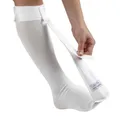
Strassburg Sock
Lightweight textile construction preferred over rigid plastic night splints in Miami's warm climate. Holds the foot in mild dorsiflexion with an adjustable strap.
One caveat: It takes 2-3 nights to adjust, and pulling the strap too tight can cause calf cramping.
Stretch your calves and arch before standing up
Pre-walk calf and plantar fascia stretching reduces the sudden fascial loading that causes first-step heel pain by gradually lengthening contracted tissue[1]. Two stretches in sequence take under 3 minutes and prepare the entire calf-Achilles-fascia chain for weight-bearing.
Before your feet touch the floor, do two stretches: a plantar fascia stretch and a calf stretch. For the fascia, sit on the bed edge and pull your toes toward your shin, hold 30 seconds, 3 reps per foot. For calves, stand facing a wall with one foot back, heel flat, knee straight, hold 30 seconds, 3 reps per side[9].
The fascia and calf muscles share a continuous chain through the Achilles tendon. Tight calves increase the pull on the Achilles, transmitting tension to the fascia at its heel attachment[5].
Never take your first steps barefoot on Miami's tile floors. Tile delivers maximum impact to an already inflamed fascia. Keep supportive slippers at your bedside and put them on before you stand.
Choose shoes with arch support and a firm heel counter
Supportive walking shoes with a moderate heel-to-toe drop and a rigid heel structure reduce plantar fascia tension at every step[9]. Replacing factory insoles with a semi-rigid orthotic adds structured arch support most stock shoes lack.
Walk in shoes with a noticeable heel-to-toe drop (most running shoes have 8-12mm) and a heel counter that passes the thumb test. Press the back of the shoe with your thumb. If the counter collapses, the shoe lacks structural support for plantar fasciitis. A raised heel reduces dorsiflexion demand at the ankle, decreasing fascial stretch during each stride[7].
Flip-flops are a daily staple in Miami, but they provide zero arch support and zero heel stability. For any walk longer than a trip to the mailbox, switch to supportive shoes. For specific recommendations, see our guide to the best shoes for plantar fasciitis.
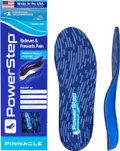
PowerStep Pinnacle Insoles
Replace factory insoles with a semi-rigid shell and deep heel cup that address both arch loading and heel impact.
One caveat: They may feel firm initially and require 1-2 weeks of break-in.
Choose firm, flat walking surfaces
Walking on firm, flat surfaces allows footwear and insoles to absorb impact rather than forcing the arch to stabilize against unstable ground[2]. Soft sand and uneven terrain increase fascial loading because the fascia must contract continuously to maintain arch integrity.
Walk on paved paths, boardwalks, and packed trails. Avoid soft sand and uneven terrain. On stable ground, your shoe and insole handle shock absorption. On shifting surfaces, the arch becomes the primary stabilizer.
Miami surfaces rated for plantar fasciitis: the Rickenbacker Causeway (paved, flat, preferred), South Pointe Park boardwalk (firm planks, good), and Bayfront Park paths (paved, good). Avoid South Beach soft sand above the tide line. If you walk the beach, stay near the waterline where sand is packed firm. For more recovery mistakes to avoid, see what not to do with plantar fasciitis.
Keep pain below 4 out of 10 and build distance gradually
A moderate pain threshold separates controlled tissue loading from damaging overload[10]. Below that level, inflammatory signaling stays low enough for collagen repair to keep pace with micro-damage. Above it, micro-tear accumulation outpaces healing and extends recovery. Start with short walks, increase gradually, and use next-morning heel pain as your primary feedback tool.
Use a 0-10 pain scale during your walk and stop if discomfort rises above a moderate level (roughly 4 out of 10 as a starting guideline). Rest for 2-3 minutes, stretch your calf and arch, then reassess. Begin with distances you can complete without increased pain the next morning, and add small increments each week[10].
Next-morning pain is more reliable than during-walk discomfort because tissue warming can mask ongoing damage. If first-step heel pain is noticeably worse than the previous morning, scale back your distance until it stabilizes.
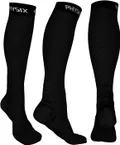
Physix Gear Compression Socks
Graduated 20-30 mmHg compression that reduces inflammatory fluid accumulation during walking. Moisture-wicking nylon handles Miami's heat better than cotton.
One caveat: Size selection is critical; the compression feels uncomfortably tight if the fit is off.
Use a short stride with a soft heel strike
A shortened stride with a soft heel strike reduces peak loading forces on the plantar fascia at every step. Leaning slightly forward, bending the leading knee, and taking shorter steps protect the fascia during both heel contact and push-off.
Lean your torso slightly forward, bend your leading knee, and shorten your stride. Tilt from your hips just a few degrees. Keep the forward knee slightly bent at contact rather than locking it straight. Land heel-first, then roll through midfoot to toe-off.
Avoid switching to a forefoot strike despite the temptation. Forefoot striking counterintuitively increases arch loading because the fascia experiences peak tension during push-off when the toe joints are fully dorsiflexed[7].
Ice, roll, and strengthen after every walk
Post-walk icing, rolling, and eccentric strengthening accelerate plantar fascia recovery and build your tolerance for progressively longer walks. This three-part protocol addresses inflammation, tissue adhesions, and calf-fascia strength in a single 15 to 25 minute session.
Complete a three-part recovery after every walk: frozen bottle rolling, lacrosse ball release, and eccentric heel drops. Sit in a chair and roll a frozen water bottle under your arch for 10-20 minutes, making one slow pass from heel to ball of foot every 2-3 seconds. The cold reduces inflammatory mediators while the rolling provides soft-tissue release[10].
If your arch is still tender, roll a lacrosse ball under your foot with moderate pressure for 2-3 minutes. A lacrosse ball is small enough for Miami hospitality workers to keep at the host stand or for Brickell City Centre retail staff to use during a break. If the firmness is too intense on inflamed tissue, use a tennis ball instead.

Lacrosse Ball
Dense rubber construction provides focused pressure across the arch. Firmer than a tennis ball for deeper fascial release.
One caveat: Start with light pressure and increase gradually. The density can feel intense on actively inflamed tissue.
Finish with eccentric heel drops on a stair edge. Lower your heel below step level over 3 seconds, return to neutral over 1 second, 3 sets of 10-15 reps per foot. Eccentric loading stimulates collagen realignment under controlled tension, strengthening the fascia at its weakest point rather than just stretching it[1].
For persistent fascial tension that rolling and eccentric loading cannot resolve, TheraMax is designed to reach the upstream calf and arch muscle restrictions that may be driving repeated flare-ups.
When to See a Professional About Your Plantar Fasciitis
See a professional if self-care has not reduced your heel pain after 4 weeks of consistent effort, or immediately if you experience any of the warning signs below. A specialist can identify the tissue-level factors contributing to fascial overload. For muscular restrictions in the calf and posterior chain, TheraMax is designed to reach depths that stretching and footwear changes cannot.
- Sudden sharp pain during a walk (possible fascial tear)
- Inability to bear weight on the affected foot
- Numbness or tingling in the foot
- Pain that worsens despite 4 or more weeks of consistent self-care
These symptoms may indicate a condition beyond typical plantar fasciitis[6].
For those in Miami, TheraMax robotic therapy on Coral Way targets the deep calf and foot muscle tension contributing to plantar fascia overload. TheraMax reaches the upstream muscle restrictions that stretching and footwear cannot access.
FAQ
If you still have questions after following the steps above, these are the ones we hear most often.
1 Will plantar fasciitis go away if I keep walking?
2 What happens if you keep walking on plantar fasciitis?
3 Should I limit walking with plantar fasciitis?
4 What should I do if plantar fasciitis is so bad I can't walk?
5 Are flip-flops making my plantar fasciitis worse?
The following clinical sources, professional association guidelines, and peer-reviewed medical journal studies support the claims and recommendations made throughout this walking guide. Citations include links to their original publications where available.
References
- Plantar Fasciitis and Bone Spurs. OrthoInfo. 2024 . Source
- Effects of Walking Direction and Slope Angle on Plantar Pressure and Muscle Activity. International Journal of Environmental Research and Public Health. 2022 ;19 (3) :1679 . Source
- Risk factors for plantar fasciitis: a matched case-control study. Journal of Bone and Joint Surgery. 2003 ;85 (5) :872-877 . PubMed
- Musculoskeletal conditions: assessment and management (NG59). NICE Guidelines. 2020 . Source
- Plantar Fasciitis. Harvard Health Publishing. 2023 . Source
- Plantar Fasciitis: Diagnosis and Treatment. Mayo Clinic. 2024 . Source
- The pathomechanics of plantar fasciitis. Sports Medicine. 2006 ;36 (7) :585-611 . PubMed
- Plantar heel pain in middle-aged and older adults: population prevalence, associations with health status and lifestyle factors. BMC Musculoskeletal Disorders. 2019 ;20 (1) :337 . PubMed
- Heel Pain (Plantar Fasciitis). APMA. 2024 . Source
- Plantar Fasciitis: Causes, Symptoms & Treatment. Cleveland Clinic Health Library. 2023 . Source
Affiliate disclosure: Some links in this article are affiliate links. We may earn a commission if you purchase through them, at no extra cost to you. Full disclosure.