



Interactive Triage
2-Minute Head & Jaw Pain Navigator
Where do you feel it most?
0 selected
Routing support only, not diagnosis. Severe neurological symptoms need urgent medical evaluation.
Headaches, neck stiffness, or jaw tension that overlap and blur together? This 2-minute quiz helps you sort the pattern and find the right starting point.
Interactive Triage
0 selected
Routing support only, not diagnosis. Severe neurological symptoms need urgent medical evaluation.
Connected Muscle System
Condition Pages

Get answers to your questions about TheraMax
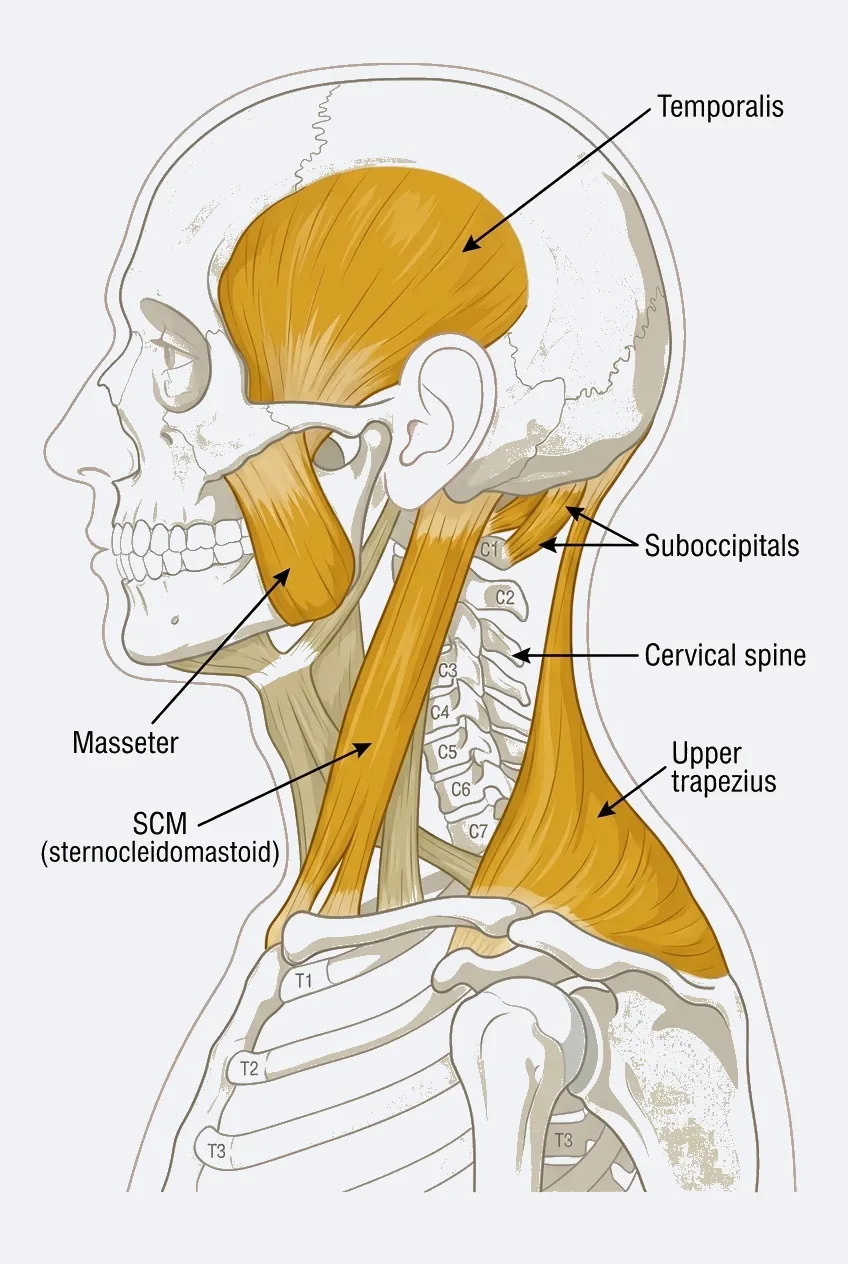
It is usually both. When the suboccipitals and upper trapezius at the base of your skull stay tight, they compress structures that refer pain upward into the temples and behind the eyes. This pattern is called a cervicogenic headache, and it blurs the line between a headache problem and a neck problem. If your headaches consistently start with neck stiffness, the neck tension is likely fueling the head pain, and TheraMax addresses the cervical chain connecting both.
Yes. The masseter and temporalis muscles that control your jaw attach directly to the temple region of your skull, and when TMJ tension keeps them overloaded the strain radiates into the temples and can trigger headaches. Clicking or popping at the jaw joint is a sign the muscles around the joint are pulling unevenly. Many clients who address the jaw tension find their temple headaches reduce at the same time, because the muscular source is shared.
Nocturnal clenching loads the masseter and temporalis while you sleep, and that tension does not stop at the jaw. The muscles of the jaw and neck share a common chain through the SCM and suboccipitals, so clenching often produces both jaw soreness and neck stiffness by morning. Addressing just the jaw or just the neck usually provides partial relief because the other half of the chain stays tight. TheraMax works both the jaw stabilizers and the cervical support muscles in the same session so neither side continues pulling on the other.
They are almost certainly connected. Sustained posture on a long I-95 commute keeps the cervical extensors and upper trapezius under constant load, and by evening that accumulated neck tension refers upward through the suboccipitals into the pressure-type headache you feel at your temples or forehead. The pattern is predictable: the longer the drive, the worse the evening headache. Addressing the cervical muscles that accumulate tension during posture-heavy tasks is key to breaking that daily cycle.
Migrating pain across the jaw, ear, and temple is a classic TMJ referral pattern. The masseter and temporalis muscles have broad attachment points across the side of the skull, and when they stay tight the pain can shift throughout the day depending on which fibers are under the most load at any given moment. Chewing, talking, and even resting your chin on your hand can change which part of the muscle is most strained. The ear involvement is common because the TMJ joint sits directly in front of the ear canal, and tension in the surrounding muscles can produce a sense of fullness or aching in the ear area.
Strategically located between Brickell and Coral Gables, our clinic is just 5 minutes from Coconut Grove and a quick drive from Downtown Miami. Whether you work downtown or live in the surrounding neighborhoods, we're easy to reach.