



Interactive Triage
2-Minute Hip & Leg Pain Navigator
Where in your hip or leg do you feel it most?
0 selected
Routing support only, not diagnosis. Severe neurological symptoms need urgent medical evaluation.
Hip stiffness, knee catching, or outer thigh tightness that you cannot quite sort out? This 2-minute quiz helps you narrow the pattern and find the right starting point.
Interactive Triage
0 selected
Routing support only, not diagnosis. Severe neurological symptoms need urgent medical evaluation.
Connected Muscle System
Condition Pages

Get answers to your questions about TheraMax
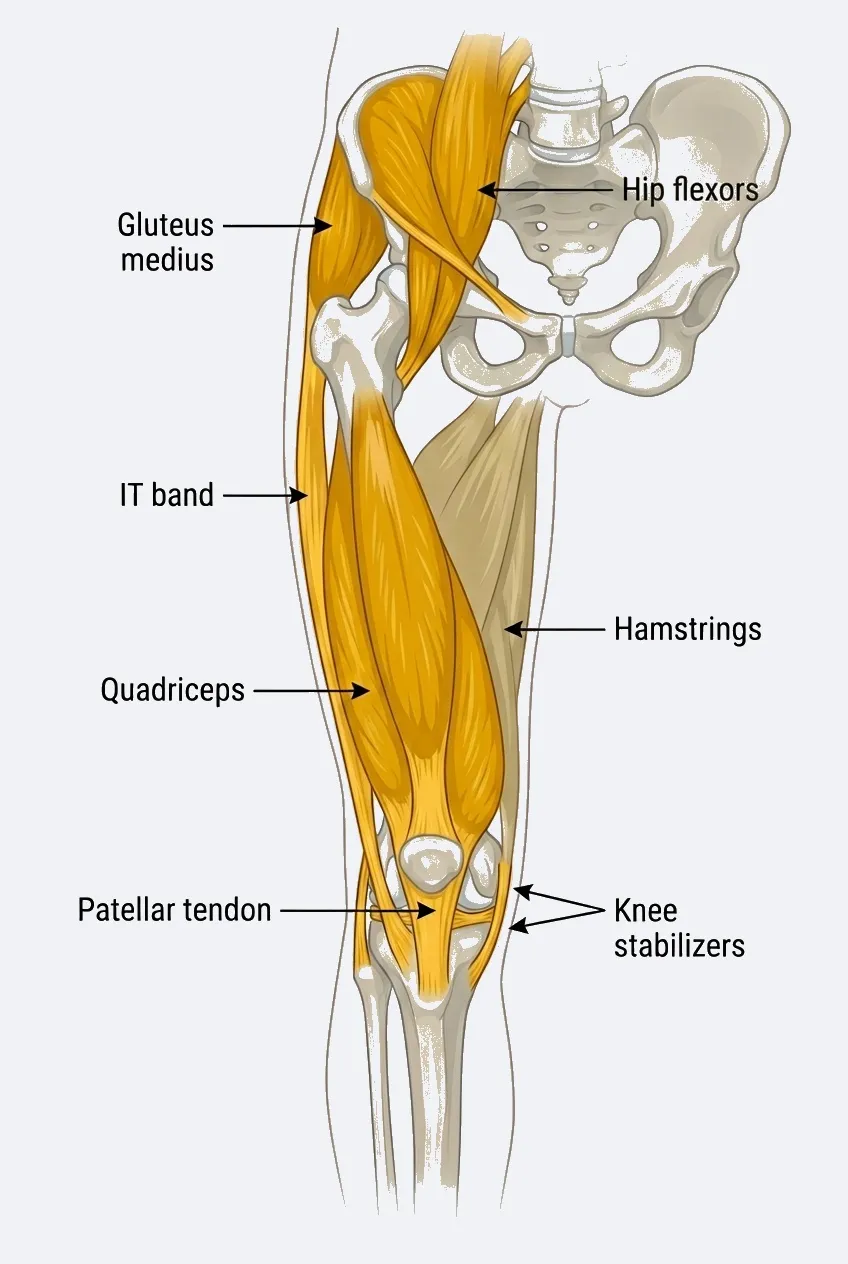
Yes, hip pain and knee pain are connected through a muscular chain that shares load with every step. When the hip flexors and glutes stay tight or weak, the knee absorbs extra force during stairs, squatting, and walking. The IT band runs along your outer thigh and connects the hip to the knee, so tension at one end often shows up at the other. Many people focus on the knee because that is where the pain is loudest, but the hip is often where the problem starts.
That pulling sensation along the outer thigh is commonly associated with IT band syndrome. The iliotibial band is a thick strip of connective tissue that runs from the hip to the knee, and when the glutes and hip rotators stay tight, it gets overloaded with each stride. The sensation often builds during a run on the Rickenbacker Causeway and disappears with rest, only to return at the same distance next time. If the pain is more in the front of your knee around the kneecap, runner's knee is more likely.
Catching, locking, or a sharp sensation during squatting and pivoting is commonly associated with a meniscus tear. The meniscus is a rubbery disc inside the knee joint that absorbs shock and stabilizes rotation, and when part of it is damaged, it can interfere with smooth joint movement. If your knee feels more achy and stiff without the catching or locking, general knee pain from muscular loading may be more relevant. Mechanical symptoms like locking and giving way tend to point toward the meniscus, while diffuse soreness that builds with activity points toward the surrounding muscles and tendons.
Front-of-knee pain that worsens with stairs, hills, and prolonged sitting is commonly associated with runner's knee (patellofemoral pain syndrome). The kneecap sits in a groove on the thighbone, and when the quadriceps and hip muscles pull unevenly, it tracks off center and creates friction with every bend. Stairs in Brickell high-rises and downhill sections of the Venetian Causeway force the knee through its loaded range, which is why those activities spike the pain. It affects runners but also anyone who does repetitive knee-bending like squats, lunges, or climbing.
Morning stiffness deep in the hip that makes car transfers, stairs, and the first steps of the day uncomfortable is typically driven by tension in the hip flexors, glutes, and deep rotators. These muscles tighten overnight and during long seated periods, and the first movements force them through range before they loosen. Many people assume the joint itself is the problem, but the surrounding muscles are usually the primary contributor to hip pain. If the stiffness radiates down the side of your thigh, the IT band may also be involved.
Strategically located between Brickell and Coral Gables, our clinic is just 5 minutes from Coconut Grove and a quick drive from Downtown Miami. Whether you work downtown or live in the surrounding neighborhoods, we're easy to reach.